Brand hall · Super Arbor

Johns
Manville

The quiet house — warm since 1858.

Johns Manville · Denver, Colorado · est. New York, 1858 A Berkshire Hathaway company · 44 plants · 80+ countries
Explore the 3D layers →

Illustrative reconstruction — not JM CAD or product photography. Machine-readable facts.

Room I

The record

One hundred sixty-seven years, in eight exhibits.

  1. Styled visualization of an 1850s roofing-materials workshop with tarred cloth rolls and a copper kettle

    Exhibit 01 — 1858

    A roofing company is born in New York

    Henry Ward Johns founds the H.W. Johns Manufacturing Company in New York City, making roofing materials. By JM’s own telling, the first shingle was made by applying hot tar to cloth with a clothes wringer and a household tea kettle.

  2. Exhibit 02 — 1886

    Manville Covering Company, Milwaukee

    Charles B. Manville establishes the Manville Covering Company in Milwaukee, Wisconsin, making pipe coverings and insulation for the steam-powered industry of the age.

  3. Exhibit 03 — 1901

    Johns meets Manville

    H.W. Johns Manufacturing and the Manville Covering Company merge to form the H.W. Johns-Manville Company — East Coast roofing manufacture joined to Midwestern insulation expertise. JM’s official timeline dates the merger to 1901.

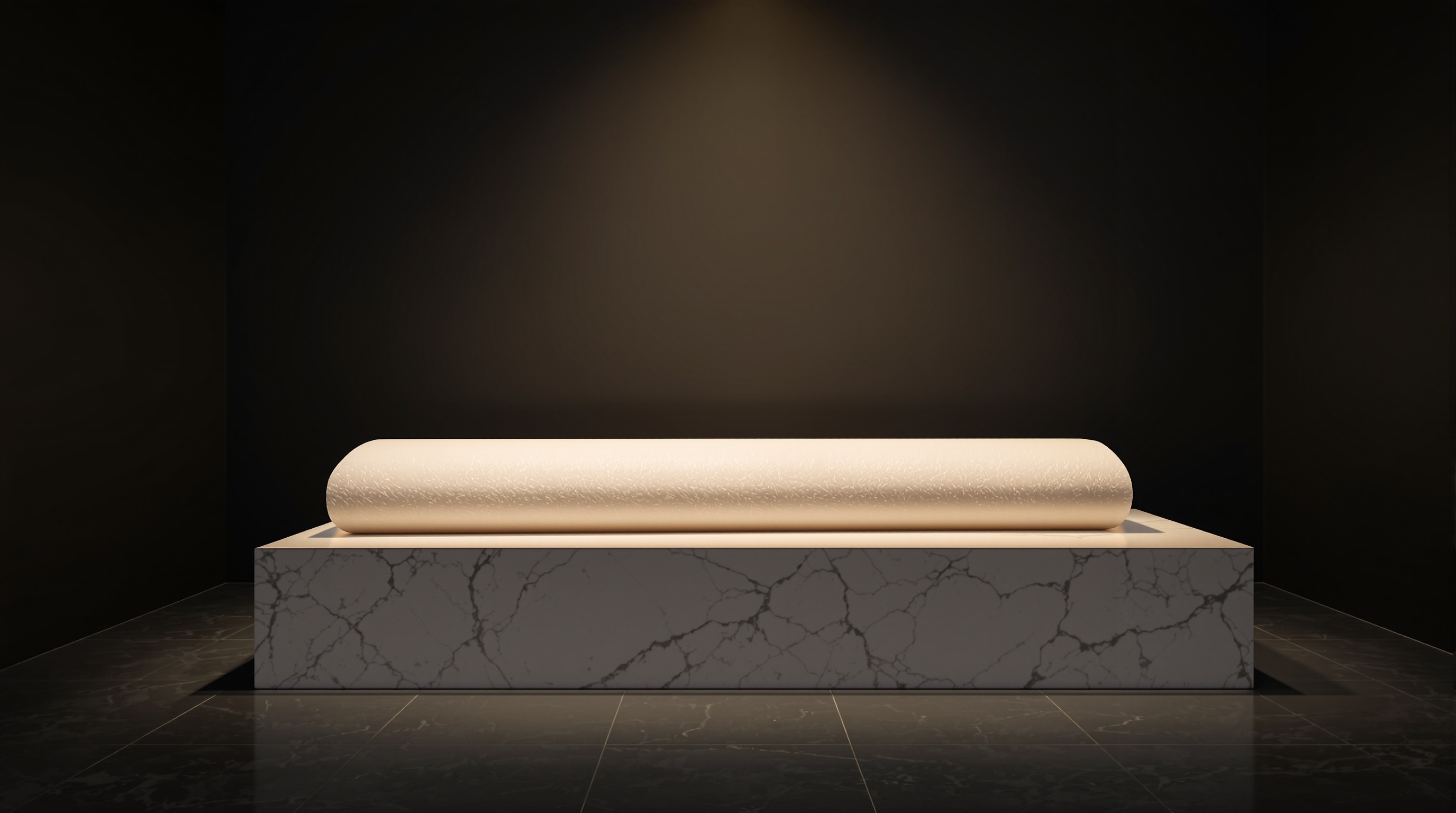
  4. Stylized macro rendering of fine white glass fibers catching warm light

    Exhibit 04 — 1958

    Entering the fiber glass era

    A century after its founding, Johns-Manville enters the fiber glass business by purchasing L.O.F. Glass Fibers of Ohio — the root of the fiberglass insulation lineage the brand is known for today.

  5. Exhibit 05 — 1972

    Denver, and a home for R&D

    Johns-Manville moves its world headquarters from New York to Denver, Colorado, and opens the Johns Manville Technical Center in Littleton — a dedicated research and development campus.

  6. Exhibit 06 — 1997

    The name restored

    Following a corporate reorganization in the 1980s — a Chapter 11 filing in 1982 and emergence in 1988 — the company returns to the Johns Manville name in 1997.

  7. Exhibit 07 — 2001

    Joining Berkshire Hathaway

    Berkshire Hathaway completes its all-cash tender offer of $13.00 per share and acquires Johns Manville on February 27, 2001. Warren Buffett called it “the opportunity to own a company with such strong market positions, leadership, and financial performance.”

  8. Exhibit 08 — 2002

    The binder switch — Formaldehyde-Free

    In March 2002, Johns Manville becomes — per JM — the first fiberglass insulation manufacturer to stop using a formaldehyde-based binder in its building insulation, switching to an acrylic binder, with all plants converted by that August. Today, per JM, its fiberglass building insulation ships Formaldehyde-Free.

Room II · Interactive exhibit

One wall, opened

The room from the hall, separated into its layers. Use the layer control to open it — the numbered plates cite their sources.

The assembly

From siding to drywall

Cladding → continuous foam board → sheathing → the stud frame with its batts and one stone bay → drywall — and overhead, the attic blanket. Open a numbered plate to inspect a layer; the rest of the room steps aside.

Room III

How to read an insulation bag

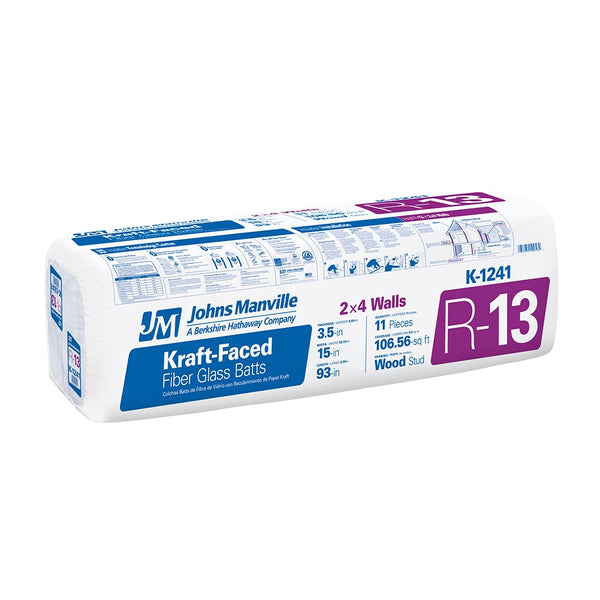
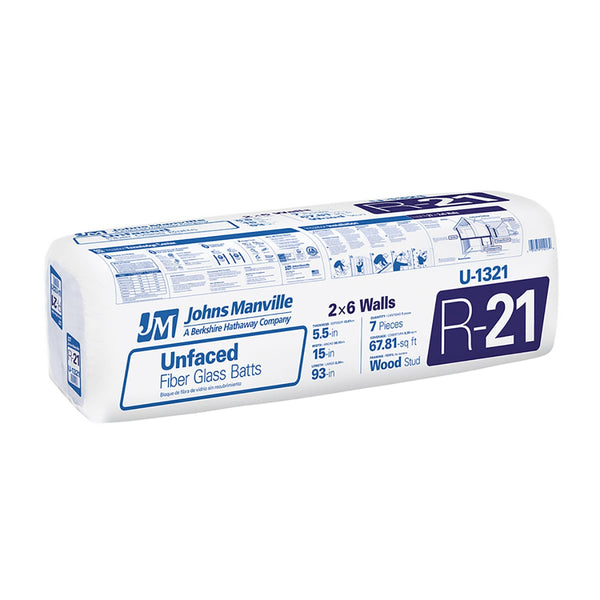
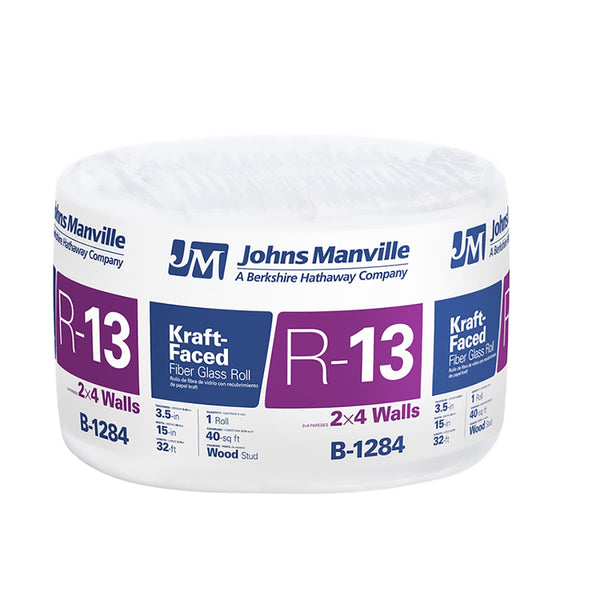
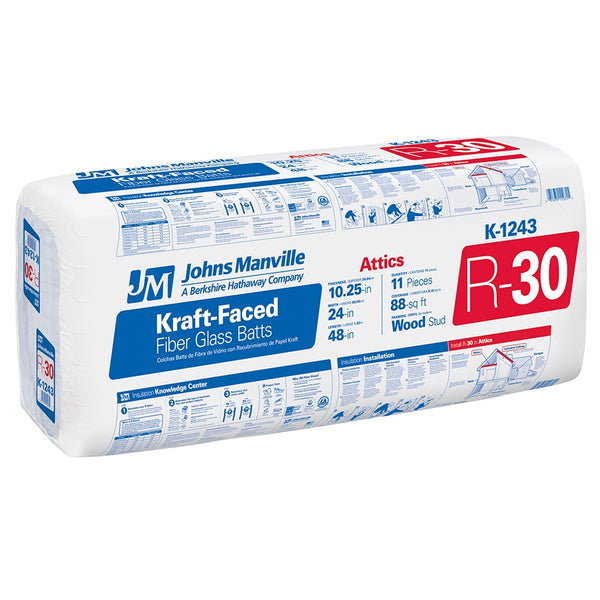
Every bag tells you three things — the R, the width, and the coverage. Read it right and the wall fits on the first order.

R-13 15¼″ 108ft²

The R-value

R-value measures resistance to conductive heat flow. Since 1979 the FTC’s R-value Rule (16 CFR Part 460) has required standardized testing behind every number printed on a bag — and dictates the label’s one-line translation, verbatim: “R means resistance to heat flow. The higher the R-value, the greater the insulating power.”

The width

Standard framing sets studs 16 or 24 inches on center. Batt widths follow: 15 and 15¼ inches for 16-inch framing, 23 inches for 24-inch — sized to sit snug in the cavity between the studs, not across them. Width, not R-value, decides whether a batt fits the wall.

The coverage

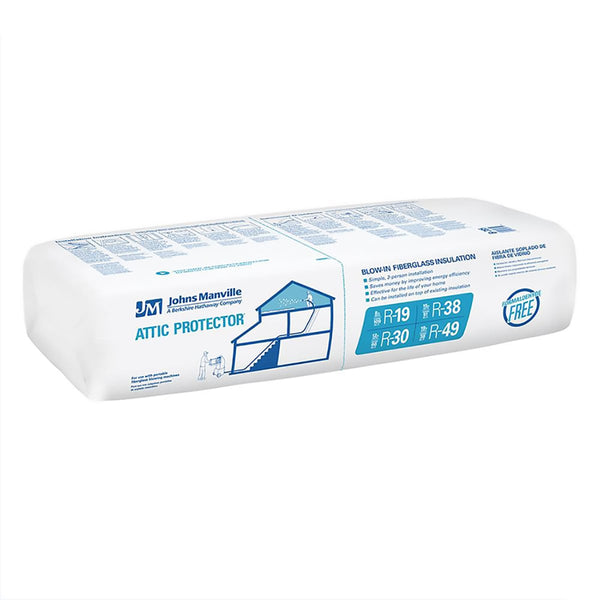
The bag is the unit — federal rule requires batt packages to state the square feet inside, and blown-in bags to chart coverage at standard R-values. Area ÷ coverage per bag = the order. Blown-in moves with depth: one Attic Protector bag covers 109 sq ft at R-19; deeper targets take more bags, per the bag’s chart.

Measure the studs first 15¼-inch batts for 16-inch centers, 23-inch for 24 — then area, facing, and only then the R.

Room IV

Glass spins. Air stands still.

Fiberglass insulation is spun glass — molten glass drawn into fine fibers that trap still air, and trapped air slows heat flow. Johns Manville was the first fiberglass insulation manufacturer to stop using a formaldehyde-based binder in its building insulation, in March 2002 — per JM — and its fiberglass building insulation ships Formaldehyde-Free today, by JM’s own account.

Room V

The works

Styled visualization of an 1850s roofing works
Styled visualization Where it started: tarred cloth, a hand wringer, and a household tea kettle — by JM’s own telling. New York, 1858.

Manufacturing facilities across North America and Europe, serving customers in more than 80 countries — per jm.com, as of July 2026. Headquarters: Denver, Colorado.

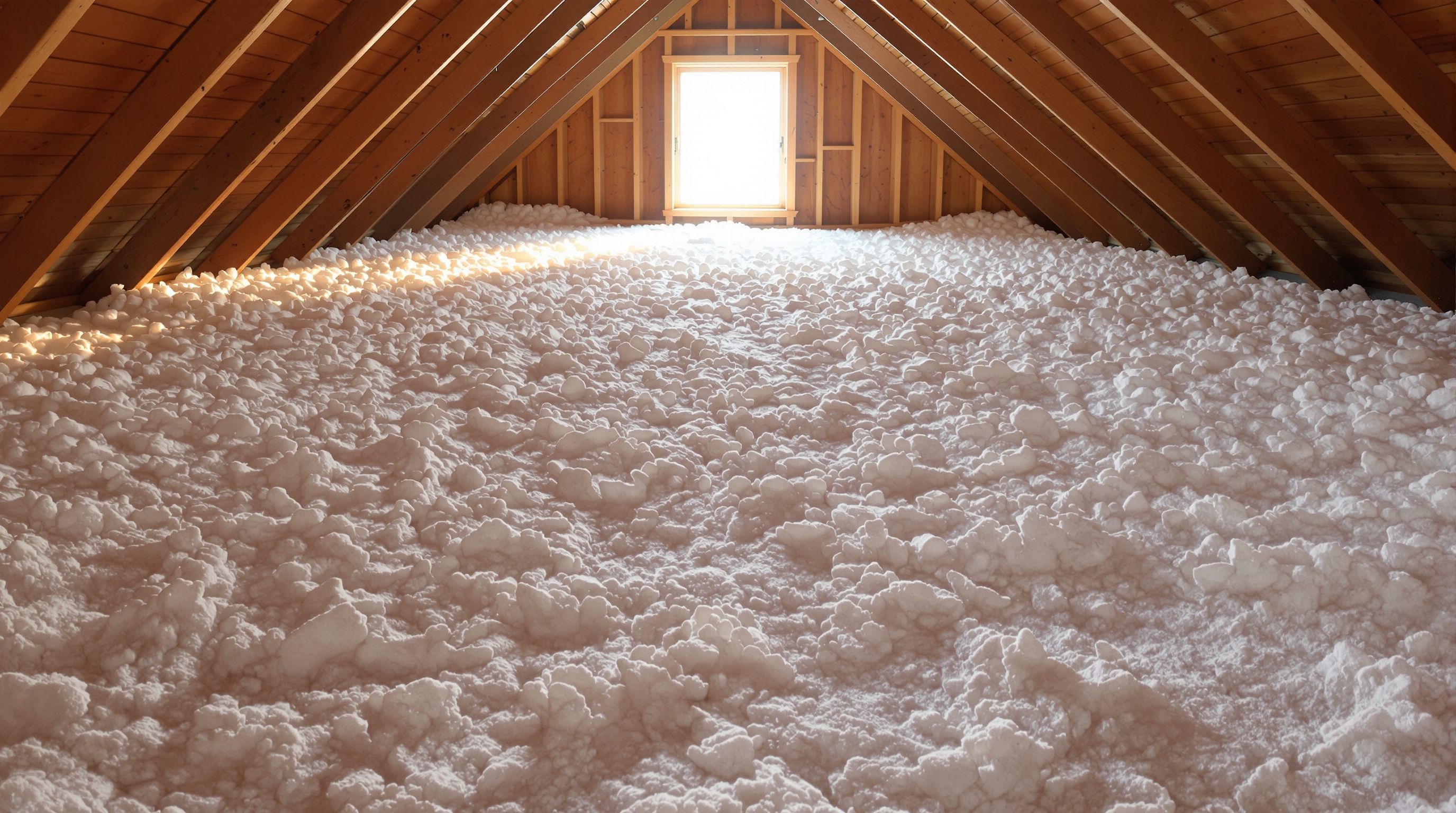
Stylized visualization of an attic blanketed in white blown-in fiberglass insulation at golden hour
Styled visualization Blown-in coverage moves with depth — one Attic Protector bag covers 109 square feet at R-19; deeper targets take more bags, per the bag’s chart.

Room VI

Three materials. One question — what’s the job?

Fiberglass — spun glass, trapped air

Molten glass drawn into fine fibers that trap still air. Batts pre-cut for stud bays, rolls that run continuous, blown-in for attic floors and irregular cavities. First to drop the formaldehyde binder, March 2002 — per JM. For framed cavities on a budget.

Mineral wool — stone, spun

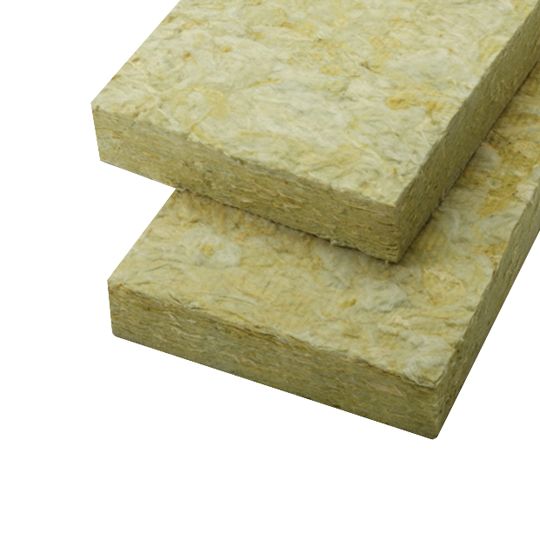
Volcanic rock, melted and spun into inorganic strands. Per JM’s SAFB documentation: noncombustible, melting point above 2,000°F, flame spread and smoke developed indexes of 0, and wall-assembly STC improvements of up to 10 dB. For where sound or fire leads the spec.

Foam board — the unbroken layer

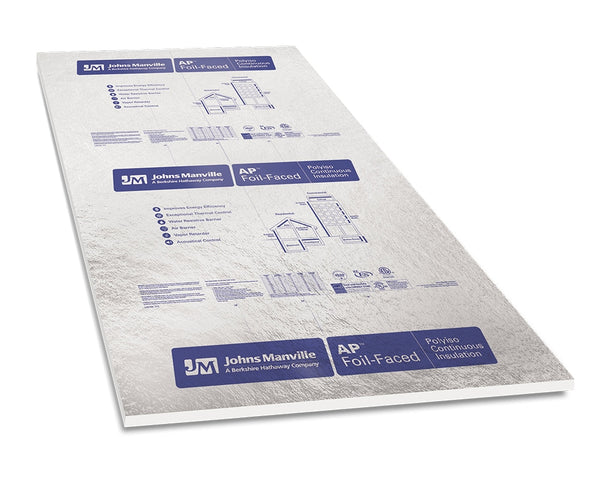
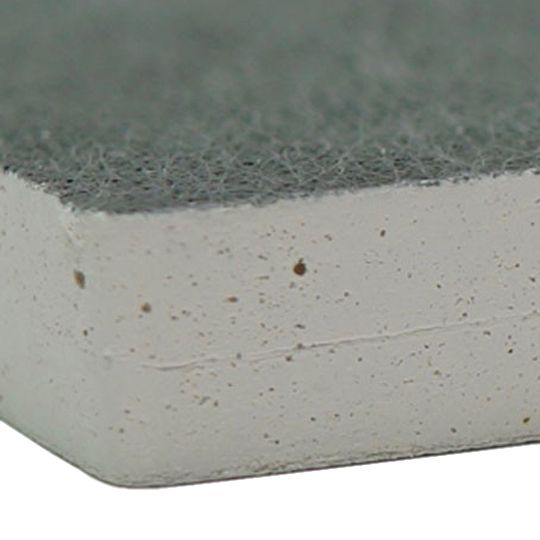
Closed-cell polyiso bonded to foil facers, sheathing the frame in one continuous thermal layer — R-6.0 at one inch on the stocked AP Foil board. Per JM’s copy, properly installed it doubles as water-resistive, vapor, and air barrier. For continuous insulation over the studs.

Compression costs R DOE guidance is blunt: compressed insulation will not deliver its full rated R-value. Buy the thickness the cavity actually takes.