Brand exhibit · Super Arbor

Rheem

From galvanized steel drums in Emeryville, 1925, to automatic gas water heaters by 1931 — one hundred years of keeping the water hot.

Rheem · Atlanta, Georgia · est. Emeryville, California, 1925 Wholly owned by Japan’s Paloma group since 1988 · per Rheem, 500+ patents across its first century
Explore the 3D model →

Styled visualization — illustrative reconstruction, not Rheem product photography. Machine-readable facts.

Room I

The record

Eight exhibits, one century.

  1. Styled visualization of a 1920s California metal works with rows of galvanized tanks
    Styled visualization

    Exhibit 01 — 1925

    Galvanizing in Emeryville

    Brothers Richard and Donald Rheem established the company in Emeryville, California, galvanizing steel drums and other metal products for the petroleum trade — a third brother, William, is named among the founders in Rheem’s own centennial telling. The family name has been on the product ever since — first on drums, soon on tanks.

  2. Stylized macro rendering of a sacrificial anode rod, pitted metal telling the corrosion story
    Styled visualization

    Exhibit 02 — 1931

    Into water heating

    Six years in, Rheem acquired the John Wood Manufacturing line and began producing automatic gas storage water heaters. Water heating became the company’s defining trade, and its own timeline notes the focus has continued to the present day.

  3. Exhibit 03 — 1947

    Heating and cooling the house

    Rheem purchased the Fraser line of gas furnaces and winter air conditioners, anticipating a market for central heating and cooling. The Rheemaire central air system followed in 1956, and HVAC has run alongside water heating in the catalog ever since.

  4. Exhibit 04 — 1960

    Ruud joins the house

    Rheem purchased Ruud Manufacturing’s water heater business, gaining a broader commercial line, a second distribution network, and — in the company’s words — a second respected brand name. Ruud remains a sister nameplate in the Rheem family today.

  5. Exhibit 05 — 1988

    A global owner, a southern address

    Rheem became a wholly owned subsidiary of Paloma Industries of Japan, one of the world’s leading producers of gas appliances, as the company’s centennial timeline records it. Operations continued under the Rheem name, and headquarters moved to Atlanta, Georgia, in 2007.

  6. Exhibit 06 — 2009

    The hybrid bet

    Per Rheem, the company was first to launch a hybrid heat pump water heater, rated at more than twice the efficiency of standard electric models. Over the following decade, heat-pump water heating moved from novelty to a mainstream residential category.

  7. Exhibit 07 — 2020

    ProTerra

    Rheem introduced ProTerra, the hybrid electric heat pump water heater it describes as the industry’s most efficient, with models rated up to 4.07 UEF. A condensing tankless line had joined the catalog in 2010, rounding out three ways to heat water.

  8. Exhibit 08 — 2025

    One hundred years

    Rheem marked a century in business — from galvanized drums in Emeryville to water heating and air systems sold worldwide. The company’s centennial telling counts more than 500 patents and an unbroken line of water heaters built since 1931.

Room II · Interactive interlude

The living tank.

Pull the light across the corner. Draw the tank down, let it recover — the hottest water stays stratified at the top for the outlet.

Drag to orbit · use the exhibit controls

Room III · Interactive exhibit

One tank, opened apart

A storage water heater, separated into the parts the spec label never mentions. Use the layer control to open it — the numbered plates cite their sources.

The assembly

Five parts the label never mentions

Jacket → foam insulation → the lined steel tank — and inside it the anode rod, the dip tube, the elements, and the T&P valve on the wall. Open a numbered plate to inspect a part; the rest of the machine steps aside.

Stylized CGI rendering — an illustration of tank construction, not a Rheem drawing.

Room IV

It corrodes on purpose.

A magnesium or aluminum rod threaded into the tank corrodes on purpose: its metal gives up electrons more readily than steel, so water attacks the rod instead of the tank wall. Rheem’s parts guidance calls anode rods the most important line of defense in extending tank life and preventing leaks — and notes that a depleted rod protects nothing. Inspection is on every use-and-care schedule.

Styled visualization

Room V · Read the label

The spec label, decoded

Every storage water heater carries the same three numbers — gallons, first-hour rating, and UEF. Only one of them sizes your house.

50 GAL FHR 62 UEF 0.93 4,500 W

Storage capacity — what it holds

Rated capacity is the water the tank physically contains — in Rheem’s EnergyGuide explainer, “the actual amount of water the unit contains.” It is the least useful number on the label for sizing: two 50-gallon units with different burners or elements deliver very different amounts of hot water in an hour. Gallons describe storage, not delivery, and buying by gallons alone is the category’s classic mistake.

First-hour rating — what it delivers

DOE defines first-hour rating as the maximum gallons of hot water a fully heated tank can supply within one hour — stored volume plus recovery rate combined. It prints on the yellow EnergyGuide label required on storage water heaters. DOE sizing guidance says to estimate the busiest hour’s hot-water demand and match FHR to it. This, not the gallon stamp, is the number that sizes a household.

Efficiency and recovery input

Uniform Energy Factor, DOE’s 2017 metric, is the share of consumed energy that ends up as hot water over a 24-hour test; compare it only within the same usage bin, which is assigned by FHR. The trailing figure is recovery input: electric tanks list element wattage, commonly 4,500 W, while gas tanks list burner input in BTU per hour — typically 40,000 on 50-gallon residential models.

Size by the first hour DOE sizing guidance says to estimate the busiest hour’s hot-water demand and match FHR to it — this, not the gallon stamp, is the number that sizes a household.

Hybrids read differently: a heat pump moves heat from the air rather than generating it, so ProTerra-class units rate up to 4.07 UEF — an efficiency multiple, not extra stored gallons. Specimen figures are illustrative of a common 50-gallon electric label; individual models vary.

Styled visualization of a water heater with copper pipes in a warm laundry corner at dusk
Styled visualization The gallon stamp holds water; the first-hour rating delivers it. DOE sizing starts at your busiest hour, not the tank size.

Room VI

The works

Styled visualization of a 1920s California metal works with rows of galvanized tanks
Styled visualization Where it started: galvanizing steel drums and other metal products for the petroleum trade. Emeryville, California, 1925.

“The company’s centennial telling counts more than 500 patents and an unbroken line of water heaters built since 1931.” — the record, Exhibit 08

Room VI · The families, explained

Tank. Tankless. Hybrid.

Three ways to heat water — standing inventory, on-demand flow, and the heat pump that moves heat instead of making it.

Storage tank — gas and electric

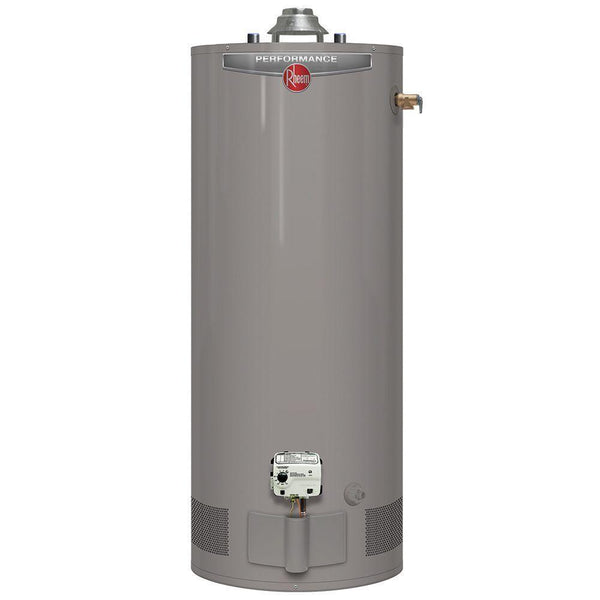
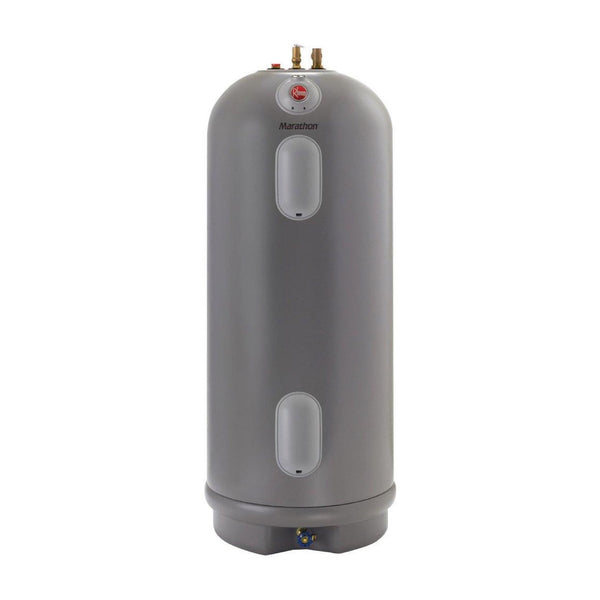
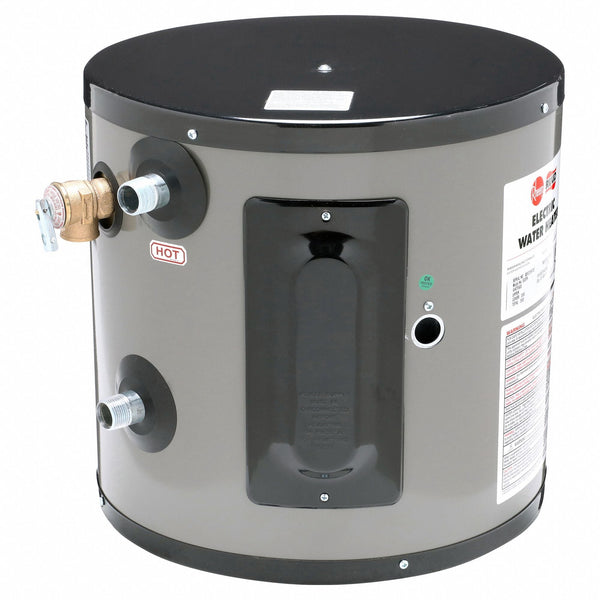
The standing-inventory model: a Rheemglas-lined steel tank keeps hot water ready around the clock, gas burner below or electric elements within. Rheem’s retail tiers carry Performance and Performance Platinum names; its contractor catalog runs Professional Classic, Classic Plus, and Prestige. Common residential sizes are 40 and 50 gallons, with short, tall, and larger formats around them; warranties run roughly six to twelve years by model. Read the first-hour rating before the gallon stamp.

The fit The like-for-like swap when fuel, venting, and floor space already exist.

Tankless — on-demand

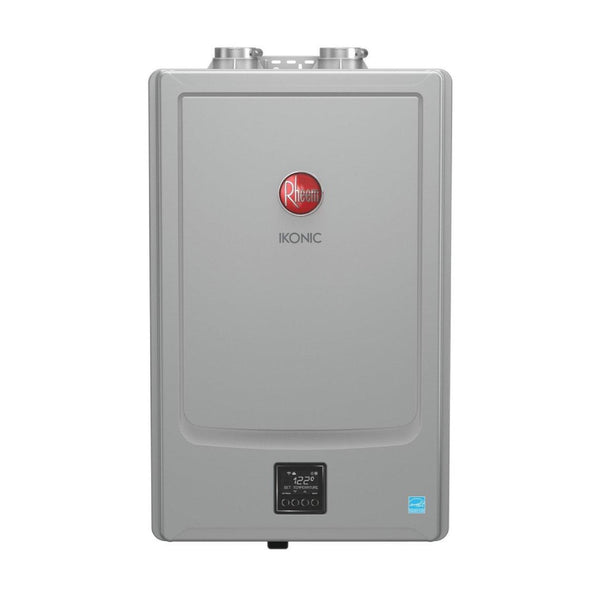
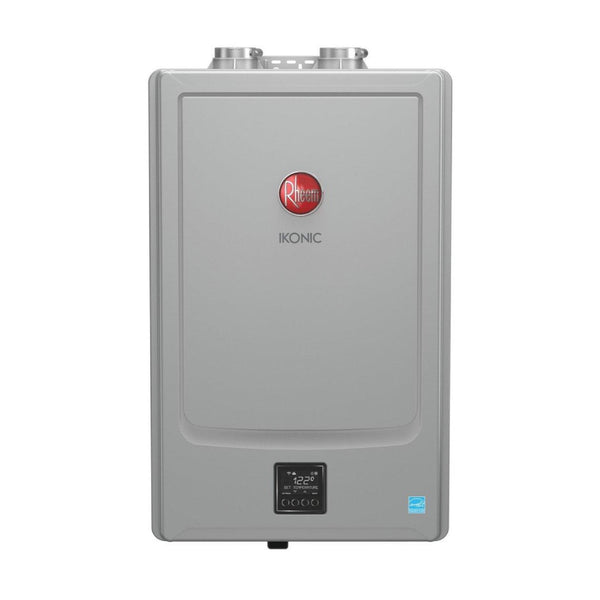
No stored gallons: water heats as it flows, so output is rated in gallons per minute at a given temperature rise rather than capacity. Rheem’s condensing IKONIC gas line runs 8.4–11.2 GPM at 0.96 UEF; non-condensing RTG models rate 0.82 UEF; compact RTEX electric units run from single-fixture point-of-use sizes up to roughly 4-GPM models. Hot water is continuous within flow limits — but sizing, gas supply, and venting are a different exercise from tanks, and a specialist’s call.

The fit Tight spaces and households that outrun a tank’s first hour — sized in GPM and temperature rise.

ProTerra — hybrid heat pump

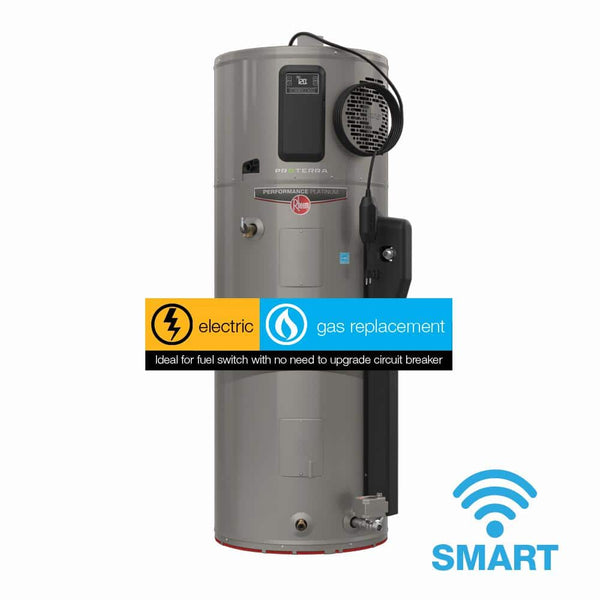
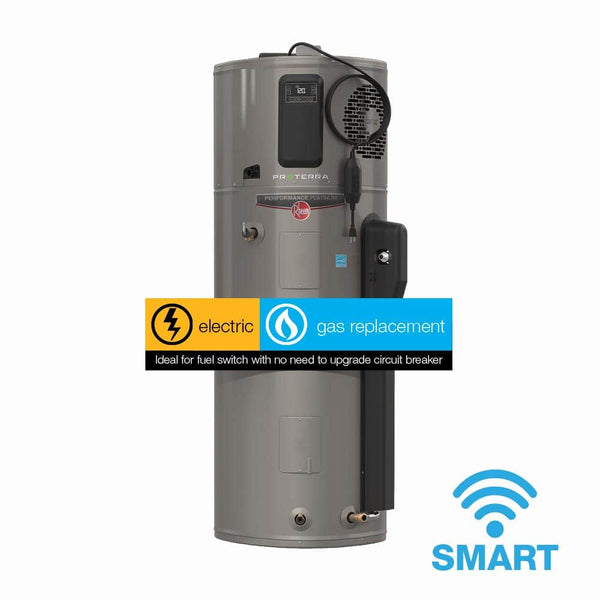
A heat pump mounted on a storage tank: it moves heat from the surrounding air into the water instead of generating it — a method New York’s NYSERDA credits with around three times the efficiency of standard electric models. Rheem rates ProTerra models up to 4.07 UEF, with resistance elements as hybrid backup for heavy draws; per Rheem, that is up to 75 percent less energy than a standard electric tank. Supply-circuit, clearance, and air-space requirements vary by model.

The fit All-electric homes chasing operating cost; confirm circuit, height, and airflow first.

Sizing notice Size by first-hour rating, not tank gallons. DOE sizing guidance matches a tank’s FHR — the hot water it can deliver in a busy hour — to your household’s peak-hour demand; a bigger tank with slow recovery can deliver less. Fuel type, venting, gas line, circuit capacity, and drainage are local-code and licensed-installer territory — confirm before purchase.

Room VII · The desk’s read

How the desk checks a water-heater order

The order logic nobody writes down — voiced as our desk’s read, not the brand’s claim.

Which line to buy

The desk’s read: the maker is identical; the tier names track the sales channel. Performance-series tanks are the retail route, while Professional Classic and Prestige models list on Rheem’s own catalog and move through plumbing distributors. If a licensed plumber is installing anyway, price both routes before defaulting to either. Then compare the honest way — first-hour rating, UEF, and warranty term, model against model, not name against name.

The sizing math

The desk’s read: count your worst hour, not your bathrooms. Add back-to-back showers, the dishwasher, and a laundry cycle in the busiest sixty minutes, then buy the first-hour rating that covers it — DOE’s method, and the reason a 40-gallon gas unit can out-deliver a 50-gallon electric. Buying gallons instead of FHR is how cold showers get purchased at full price.

The operating-cost math

The desk’s read: the sticker is the down payment; UEF sets the monthly bill. Check the EnergyGuide label’s estimated yearly cost, then run it against your own utility rate before comparing prices. A heat-pump unit near 4.0 UEF against a resistance tank near 0.93 is the widest efficiency spread in the aisle — worth the arithmetic, and worth confirming the install requirements before the savings are spent.

First buy: the anode habit

The desk’s read: if you are replacing a failed tank, ask what killed it — tanks commonly fail by internal corrosion once the sacrificial anode is spent, which is the part’s whole job. Start the new one differently: put an anode inspection on the calendar per the use-and-care manual, flush sediment on the same schedule, and know where the T&P valve discharges. It is the cheapest ownership habit in water heating.

Put your busiest hour on a list — showers, dishwasher, laundry — and a specialist sizes the first-hour rating before you buy.